Customer discovery is a reading problem
Founders treat customer discovery as a talking problem and schedule interviews. The people who already told you the truth did it in writing, months ago, in public.
The standard advice is to go talk to users. Book the calls, ask open questions, do not pitch. It is good advice, and it is also the reason most founders stall. Talking is slow, it is biased toward the people willing to take your call, and it asks strangers to reconstruct from memory what they felt months ago.
There is a faster corpus, and you did not have to schedule it. Your prospective customers have already described their problem, in their own words, in public — on Reddit, on Hacker News, in Indie Hackers threads, in the replies to someone else's launch. Customer discovery is less a talking problem than a reading problem. The transcript exists. Most founders never open it.
The people who will tell you the truth already did, in writing, before you asked.
Why the written record beats the interview
An interview is a performance for an audience of one — you. People soften complaints, flatter the idea in front of them, and forget the specifics that matter. A forum post written in frustration at 1 a.m., to an audience of peers, has none of that. It is unguarded, time-stamped, and specific. It names the tool that failed, the workaround, the price that finally felt like too much.
Read enough of those and three things fall out that interviews rarely surface cleanly:
- The exact vocabulary your market uses — which is the language your landing page should use back.
- The moment of pain, described in context, not abstracted into a feature request.
- Named voices describing the problem right now, each quoted and linked to the public post it came from.
The method, in three moves
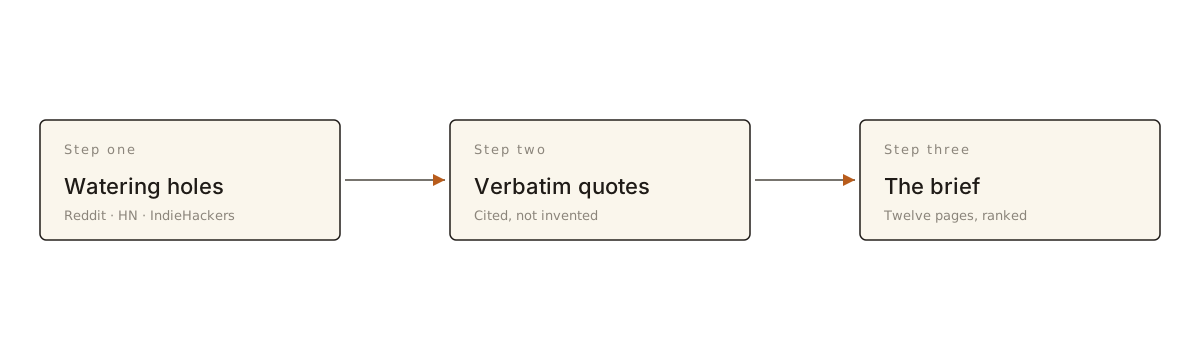
The work is unglamorous. Find the communities where your customer already gathers. Read until patterns repeat. Keep the verbatim quote and its link, not your paraphrase — the paraphrase is where the bias creeps back in. Then rank: which pains are loud, which are merely annoying, which would someone pay to make stop.
Laid out as a pipeline, it looks like this:
flowchart LR
  A[Define the persona] --> B[Find their watering holes]
  B --> C[Read for repeated pain]
  C --> D[Keep verbatim quotes + citations]
  D --> E[Rank by willingness to pay]
  E --> F[Brief]
What a quote is worth versus a summary
A summary tells you people dislike onboarding. A quote tells you why, in words you can quote back. The difference is the difference between a brief you act on and a brief you nod at.
| Signal | Interview | The written record |
|---|---|---|
| Specificity | Reconstructed from memory | Written in the moment |
| Bias | Toward your idea | Toward their peers |
| Vocabulary | Yours, leading them | Theirs, unprompted |
| Reachability | The one person on the call | Everyone in the thread |
None of this means stop talking to customers. It means do the reading first, so that when you do book the call you already know what to ask — and you are confirming a pattern instead of fishing for one.
That inline arrow is a themeable SVG — its stroke is currentColor, so it
takes the brand terracotta without a separate asset.
This is the wager briff is built on. Before you build, read the room.